
PROJECT
LOCH NESS
What is Loch Ness?
Project Loch Ness is an underwater stealth technology demonstrator that leverages magnetohydrodynamic (MHD) propulsion to defend against passive sonar. Passive sonar is the mode of enemy detection which “listens,” whereas active sonar is the action of emitting sonar pings and reading their return signal—similar to radar. Passive sonar has been the primary detection method since World War I.
MHD propulsion has the potential to drastically reduce the acoustic signature of a vessel because it has no moving components and therefore produces no vibrations. Despite significant advancements over the last century, traditional propulsion mechanisms, such as propellers, pump-jets, and rim-driven thrusters, still have rotating parts and therefore produce vibration-induced noise.
Project Loch Ness seeks to improve existing MHD technology inexpensively and examine the tradeoffs in mechanical performance (i.e., thrust and efficiency) for stealth improvements to determine the viability of MHD in next-generation stealth submersibles.
What is magnetohydrodynamic propulsion?
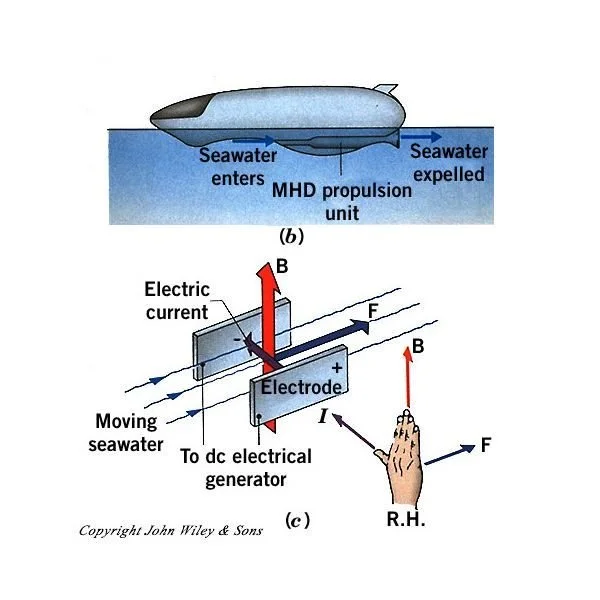
As mentioned, MHD drives produce thrust without any moving parts. This is accomplished by creating a Lorentz force. The Lorentz force is produced by perpendicularly crossing a magnetic and an electric field in a conductive fluid, such as saltwater. In concept, this is very simple, but the thrust and efficiency associated with MHD drives are limited by material technology, specifically in corrosion-resistant electrodes and magnetic field strength. Project Loch Ness does not seek to produce new materials to solve these issues, but to exploit existing technology in clever ways to improve mechanical characteristics.

Plasma Channel, YouTube